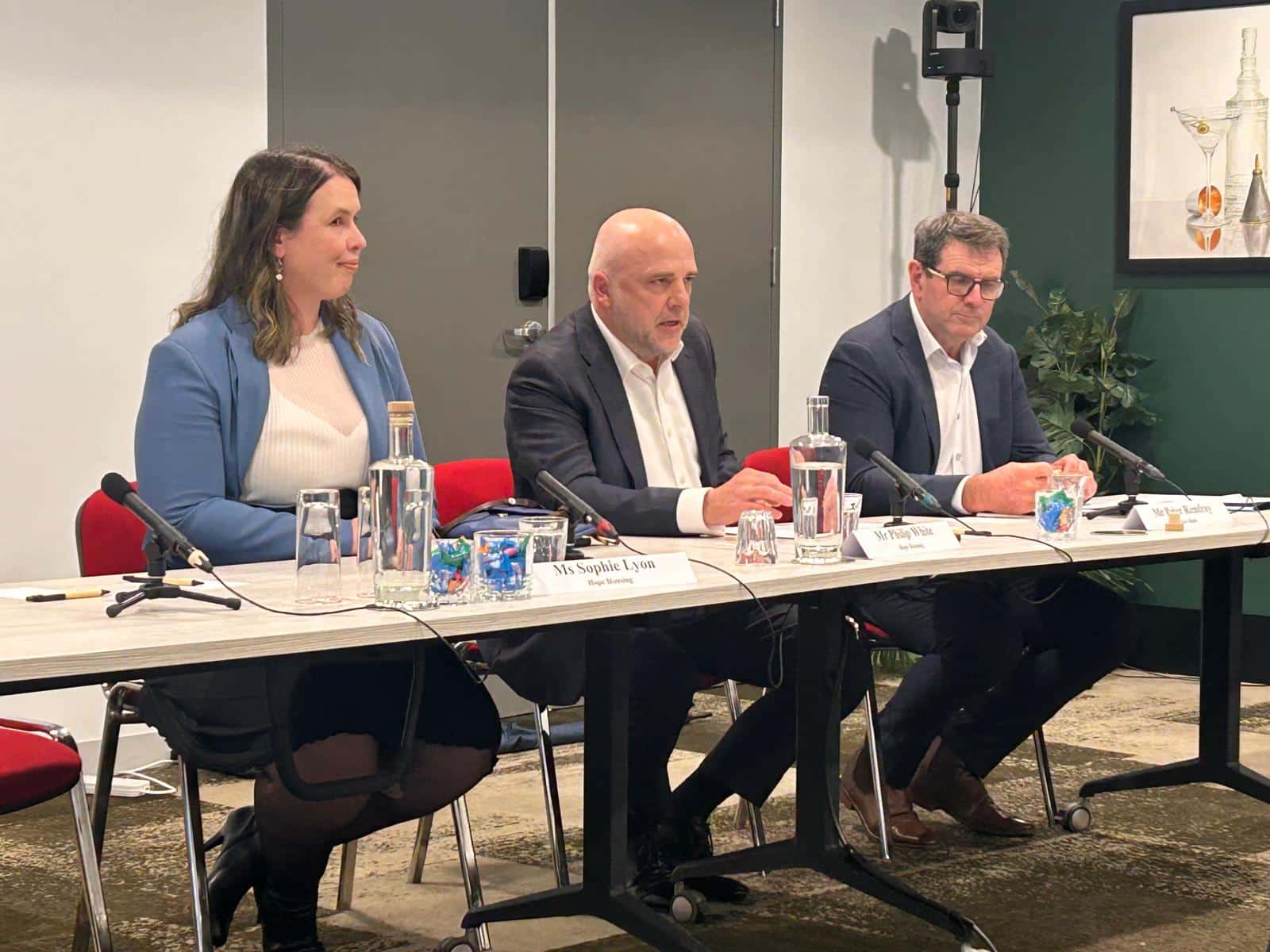
HOPE Housing appeared before the Senate Select Committee on Intergenerational Housing Inequity in Sydney on 7 July, highlighting the growing barriers essential workers face in buying a home in the communities they serve.
HOPE CEO Phil White appeared alongside Peter Remfrey, Chair of Police Bank, and Sophie, an Application Specialist and Intensive Care Nurse at St Vincent’s Hospital who purchased her Sydney home with the support of HOPE.
The hearing provided an important opportunity to demonstrate how HOPE’s shared equity model aims to create a practical pathway into homeownership for essential workers who may earn above the income caps of government programs, such as Help to Buy, but remain unable to purchase a suitable home close to work.
“Increasingly, experienced essential workers are being locked out of homeownership, despite earning stable incomes and making a critical contribution to their communities,” Mr White said.
“HOPE provides a practical solution by bringing together investor capital and essential workers to help them buy a home in the communities they serve. With the right support, we believe this model can be scaled to help many more essential workers across Australia.”
The scale of the affordability challenge was made clear in HOPE’s opening remarks. In 1999, a registered nurse in Sydney needed around five times their annual wage to purchase a median priced house. Today, it takes more than 18 times their annual wage.
In her closing remarks, Senator Barbara Pocock described the statistics as “powerful evidence”, reinforcing the urgent need for practical and scalable homeownership solutions.
The appearance outlined how government support could help accelerate the growth of affordable homeownership models, such as HOPE.
Sophie brought the issue to life by sharing her experience with HOPE that enabled her to break the cycle of shared housing and relocating every 12 months. Buying a home with HOPE has removed the cost, disruption and uncertainty of renting, providing her with greater financial security and allowing her to focus on her critically important work.
Peter Remfrey also highlighted the consequences when essential workers cannot afford to live close to work. He spoke about police officers commuting to Sydney from the Central Coast and, in some cases, sleeping in their cars between shifts because there is not enough time to travel home and return to work. It was a powerful example of why access to homeownership close to work matters for essential workers, their families and the communities they serve.
Essential workers perform the jobs our communities depend on. HOPE will continue advocating for solutions that give them a genuine opportunity to own a home in the communities they serve.